🇮🇹🇩🇪🇫🇷🇪🇸🇵🇹🇳🇱🇵🇱🇸🇪🇩🇰🇫🇮🇨🇿🇷🇴🇭🇺🇬🇷🇧🇬🇭🇷🇸🇰🇸🇮🇪🇪🇱🇹🇱🇻🇮🇪🇲🇹🇸🇦🇨🇳🇯🇵🇰🇷🇮🇳🇹🇷🇻🇳🇮🇩
There is a claim embedded in almost every textile sustainability audit process: if the Transaction Certificates are present and formally valid, the supply chain is covered. The certification bodies have done their job. The platform has done its job. The brand has done its job.
This claim is false.
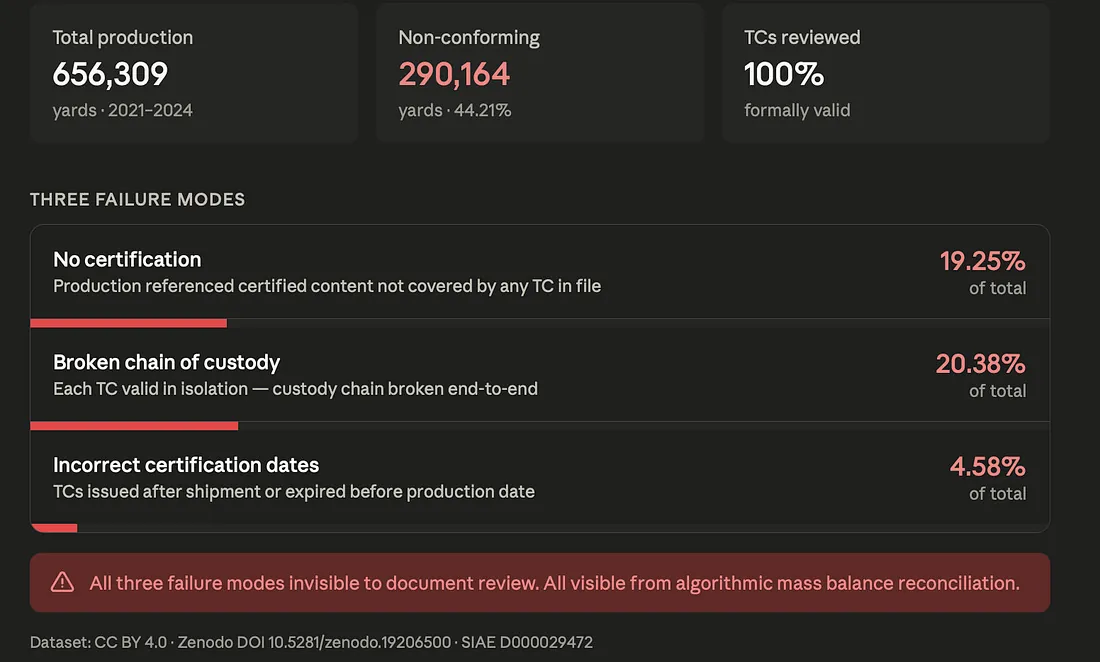
I can say this with precision because I have the data. A three-year industrial audit — one international apparel brand operating in the UK market, 2021–2024, primary claim: 20% certified recycled linen content across a linen/hemp range — produced 656,309 yards of production records. Every Transaction Certificate in the brand’s files was formally valid. The issuing certification bodies were accredited. The documents were present.
44.21% of the material — 290,164 yards — failed algorithmic mass balance verification.
This is not a rounding error. It is not a data quality problem. It is a structural failure in how the textile industry counts certified material.
The failure was invisible to document review
Standard compliance audits check three things: that a certificate exists, that it is within its validity period, and that the certification body is accredited. All three conditions were satisfied across the entire dataset. A document reviewer — human or automated — would have cleared this supply chain without a flag.
The 44.21% non-conformity only became visible when the certified volumes in each Transaction Certificate were reconciled, garment by garment, against the actual production quantities that consumed them.
The non-conformity decomposed into three structurally distinct failure modes:
19.25% of the material had no certification at all. The production records referenced certified content that no Transaction Certificate in the brand’s files actually covered. The gap was not a missing document — it was a missing supply chain link that document review had no method to detect.
20.38% had an incorrect or incomplete chain of custody. Transaction Certificates existed, but the custody chain between them contained breaks — mill-level certificates that did not trace back to the fiber-level certificate, or scope certificates that covered a different production scope than the one declared. Each certificate, read in isolation, was valid. The chain, read end-to-end, was not.
4.58% had incorrect certification shipping dates. Transaction Certificates were referenced against production batches they did not temporally cover — the certificate was issued after the shipment it was cited as backing, or had expired before the production date it was attributed to. Date validation is straightforward arithmetic. It was not performed.
Three failure modes. Zero visible from document review. All visible from algorithmic reconciliation.
Why this is a structural problem, not a data quality problem
The instinctive response to a 44% non-conformity figure is to diagnose the specific brand, the specific supply chain, or the specific period. I want to resist that framing, because it mislocates the cause.
The supply chain in question is not unusual. It involves a multi-tier structure — European brand, Asian mill, fiber supplier, certification body — of the kind that the GRS, RCS, GOTS, and OCS schemes were designed to govern. The brand had invested in sustainability documentation. The certificates were real. The certification bodies were legitimate.
The structural problem is this: a Transaction Certificate certifying a volume of recycled material in kilograms does not, by itself, tell you how many garments that volume covers. That answer requires knowing the fabric weight (GSM), the cut width, and the yield coefficient for each production batch — and then performing the arithmetic, batch by batch, against the cumulative certified balance. This computation does not happen automatically when a certificate is uploaded to a compliance platform. In almost every DPP and traceability system currently on the market, it does not happen at all.
I documented this gap formally in the CIRPASS-2 stakeholder consultation in January 2026 (Contribution ID: bb6997ac-957f-40c5-894c-9175f17ed682): a certificate that certifies a quantity of recycled material does not, by itself, indicate how many garments that quantity covers. The observation was not contested.
The consequence is direct. If a brand issues Digital Product Passports declaring 20% certified recycled content across 1,000 garments, and the certified volume in their Transaction Certificates covers the equivalent of 556 garments’ worth of recycled fiber — the DPPs for the remaining 444 garments carry a declaration that cannot be backed by certified evidence. The documents are all present. The math does not close.
The regulatory timeline does not allow this to remain invisible
Directive (EU) 2024/825 — Empowering Consumers for the Green Transition, amending the Unfair Commercial Practices Directive 2005/29/CE — applies from 27 September 2026. For widespread infringements, its enforcement framework provides for penalties of up to 4% of the trader’s annual turnover. The liability falls on the trader making the claim — the brand — not on the platform that issued the passport.
ESPR (Regulation (EU) 2024/1781) adds a separate enforcement path: market surveillance, the EU DPP Registry (operational from 19 July 2026), and member state penalties, with the textile delegated act expected in late 2026 to 2027.
Both instruments share an architectural assumption: that the sustainability claims in a Digital Product Passport are verifiable — not merely that documents supporting them exist, but that the quantities declared are reconcilable with certified upstream evidence. This assumption is not currently satisfied by any DPP platform that operates at the level of document collection.
A brand that has cleared its internal compliance review because all certificates are present is not protected under either instrument if the per-unit math does not close. The certificates confirm the existence of certified material. They do not confirm that the declared per-unit content is covered by the certified volume. That confirmation requires the reconciliation layer — and the reconciliation layer is currently missing from the market.
What the reconciliation layer actually computes
The method is not complex. It is just arithmetic that no one was performing.
Let TC(i) be the certified material volume, in kilograms, for Transaction Certificate i. Let G(j) be the per-garment certified material consumption for production batch j — derived from fabric weight (GSM), cut width (CW), and yield coefficient — and Q(j) the batch quantity, so that G(j) × Q(j) is the certified material consumed by that batch. The running balance for a season is:
Balance(t) = Σ TC(i) − Σ G(j) × Q(j)
A batch is covered if and only if Balance(t) ≥ G(next batch) × Q(next batch).
The per-garment consumption is derived from physical fabric parameters — not from a self-declared certified weight on a document. This matters: it means the kilograms entering the balance are recalculated from the physics of the shipment, never taken from an unverified documentary figure.
The coverage verdict is a property of the claim, not a condition of passport issuance. Under ESPR, the passport is mandatory — a platform does not withhold it, does not stop shipments. What the reconciliation determines is what the credential can assert. Units not covered by the certified balance are declared conventional, not recycled. The passport is still issued. The brand is informed. The claim remains true.
The audit dataset referenced in this post — 656,309 yards, three years, three failure modes — is published in full under CC BY 4.0 in the working paper that first formalized this method (Zenodo DOI: 10.5281/zenodo.19206500, March 2026). The methodology is SIAE-deposited (D000029472, 28 April 2026). The dataset is there for anyone who wants to replicate the analysis against a different supply chain.
The question that survives any adjustment of the numbers
The 44.21% figure is from one deployment, one brand, one supply chain. I make no claim about its representativeness as a population estimate. The figure may be higher in some supply chains, lower in others.
The question that survives any adjustment of the numbers is this: how would you know?
Document review cannot answer it. A compliance platform that ingests certificates and marks fields as complete cannot answer it. A DPP platform that issues a signed credential carrying a certified content claim without having performed the per-unit reconciliation cannot answer it.
The only answer requires computing the balance — Transaction Certificate by Transaction Certificate, batch by batch — and comparing the cumulative certified volume against the cumulative declared consumption. That computation is not in the certificate. It is not in the DPP schema. It is not in any delegation act currently in force.
It is the check that was not run on 290,164 yards of production that someone declared as certified.
Stefano Cipriani is founder of Reeco®, Expert Member of CIRPASS-2 (EWG1, EWG3), JRC Registered Stakeholder (Seville), and a listed UN/CEFACT UNTP implementer (MR !732, merged April 2026). ORCID: 0009-0001-3423-9402. The full audit dataset is available at Zenodo DOI 10.5281/zenodo.19206500.