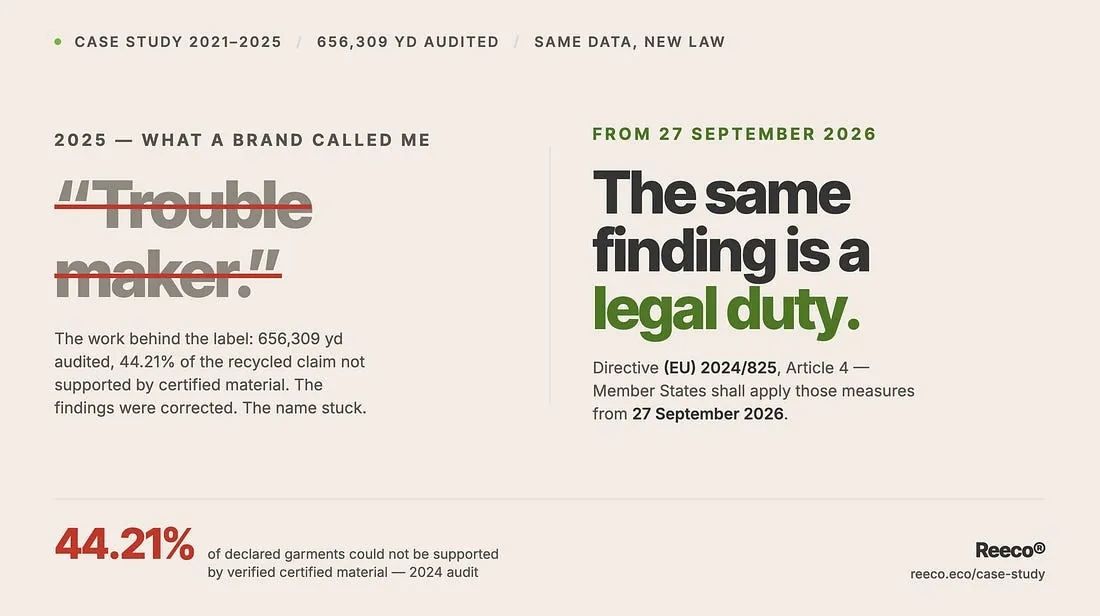
In 2025 a brand called me a trouble maker.
Not in an email. Said out loud, in the tone people use for someone who has slowed the meeting down. I have thought about that phrase for a year, and I have stopped being offended by it — because in 2025 it was, from where they were sitting, a rational thing to say.
On 27 September 2026, sixty days from today, it stops being rational.
What earned the label
The work is public. Over four years Reeco® verified GRS recycled-content claims across a multi-supplier linen programme. The 2024 audit alone covered 656,309 yards. Every metre was cross-referenced against Transaction Certificates from four fabric suppliers, then run through a per-garment mass balance using actual GSM, cut width and yield.
The result: 44.21% of declared garments could not be supported by verified certified material. 290,164 yards, split into three failure modes:
126,313 yd — no valid certification found
133,787 yd — wrong or incomplete chain of custody
30,063 yd — certified shipping dates outside the valid window
Here is the part that people still get wrong when I present it. None of those certificates were fake. Every one of them was a real, issued, formally valid document from a real certification body. The gap is structural: a Transaction Certificate attests an aggregate volume moving between two operators over a period. A DPP claim attests grams of certified fibre in this garment. Nothing in the first document computes the second. The arithmetic lives in the space between them, and until someone does that arithmetic, “we have the certificate” and “the claim is true” are two different statements.
I wrote the full technical version of this in June — The certificates were all valid. (44% of the material was not) — and the case study is on the site: reeco.eco/case-study.
Why “trouble maker” was the correct word in 2025
Put yourself on their side of the table.
Someone external arrives with a number that says nearly half of a sustainability claim you have already printed, already merchandised, already put in a press release, does not hold. Acting on it costs money, time, supplier conversations and internal credibility. Ignoring it costs, in 2025, nothing. No authority was going to ask. No competitor could sue. No consumer could check.
When the cost of knowing is high and the cost of not knowing is zero, the person who insists on knowing is not a partner. He is friction. He is a trouble maker. That is not malice, it is incentive structure — and I would rather describe it accurately than complain about it.
I have never assumed bad faith in that room. What I object to is a system that made ignorance free.
What changes in sixty days
Directive (EU) 2024/825 — empowering consumers for the green transition — Article 4: Member States “shall apply those measures from 27 September 2026.”
That single line moves the cost. Not to me, not to the auditor: to the party making the claim.
Italy has already transposed it. Legislative Decree 30/2026, published in Gazzetta Ufficiale no. 56 of 9 March 2026, in force since 24 March, Article 2(1): “Le disposizioni del presente decreto si applicano a decorrere dal 27 settembre 2026.” It writes “environmental claim”, “generic environmental claim” and “certification scheme” into the Consumer Code as legal definitions — a certification scheme now has to be open, transparent and monitored by an independent third party to count at all.
Germany transposed with teeth attached: an administrative fine of up to 4% of annual turnover, where turnover means revenue in the EU Member States affected by the infringement — and where turnover cannot be established, a flat ceiling of €2 million. The Czech transposition sets the same 4%, with a CZK 50,000,000 fallback. These are the widespread-infringement figures, not the routine ones, and they will not be the common outcome. But they exist now, and in 2025 they did not.
Then ESPR. The first Working Plan puts textiles in 2027 for the delegated act; the delegated act scope is apparel, including clothing accessories. Enforcement follows. At that point the claim does not merely have to be true — it has to be machine-verifiable by a market surveillance authority reading a Digital Product Passport.
The verdict flips, and I did not do anything
This is the part I want to be precise about, because it would be easy — and cheap — to write this post as I was right and they were wrong.
I do not think that.
I ran the same audit, with the same method, on the same kind of data, in 2024 and I would run it identically tomorrow. Nothing about my work improved. What changed is who pays for the finding. Before 27 September 2026, a brand that heard “44.21% is unsupported” and did nothing carried a reputational risk. After 27 September 2026, the same brand carries a legal one, with a defined authority, a defined procedure and a defined fine.
The person who brings you an inconvenient number does not become smarter when the law arrives. He becomes cheaper than the alternative. That is the whole reversal, and it is not flattering to anybody — including me.
So no, I do not expect that brand to change its opinion of me. I expect it to change its filing cabinet. Those are different things, and only one of them is my business.
What I would say to that room today
Three things, and none of them require liking me.
Run the audit before the market does. The finding is identical whether it comes from your verification layer in March or from an authority in November. The cost is not.
A document system is not a verification system. If your DPP platform works by uploading a certificate and ticking “compliant”, you have digitised the paperwork, not the claim. The delegated act will ask for the computation, not the PDF.
You want to be the one who found it. From 27 September, “we detected it and corrected it” and “we were told by a regulator” are the same set of facts with two very different outcomes.
The brand in the case study did correct the findings before anything reached the market. That happened while nothing at all compelled it. I would like the record to show that, because it is the most useful part of the story: the correction was always possible. The only thing that was missing was a reason.
In sixty days, there is a reason.
Stefano Cipriani is founder of Reeco®, an Expert Member of CIRPASS-2 (EWG1, EWG3), and a JRC Registered Stakeholder. The 2024 audit methodology is deposited on Zenodo (DOI 10.5281/zenodo.19206500); the case study is at reeco.eco/case-study. Brand and supplier identities are not the subject of this post and are not discussed in it.
Sources for the legal dates, verifiable line by line: Directive (EU) 2024/825, Article 4 (Transposition). Italy: D.Lgs. 30/2026, Gazzetta Ufficiale no. 56 of 09/03/2026, Article 2(1). Germany: transposition act of 2026, penalty provision at 4% of annual turnover in the affected Member States, €2 million floor. Czech Republic: 4% of total annual turnover, CZK 50,000,000 fallback. ESPR first Working Plan (April 2025): textiles delegated act indicated for 2027.
Disclosure: language drafting of this document was assisted by a large language model. All the rest (concepts, data, analysis and conclusions) are the author’s own, verified against primary sources.