"Our passport is signed and tamper-proof."
Ask what that sentence actually guarantees.
It guarantees the file was not altered after issuance and nothing about whether the numbers inside were ever reconciled.
A signature is an integrity check, not a truth claim.
So here are three questions worth asking any DPP provider (ours included):
Can a third party verify your passport without asking you for permission, or does verification route through your servers?
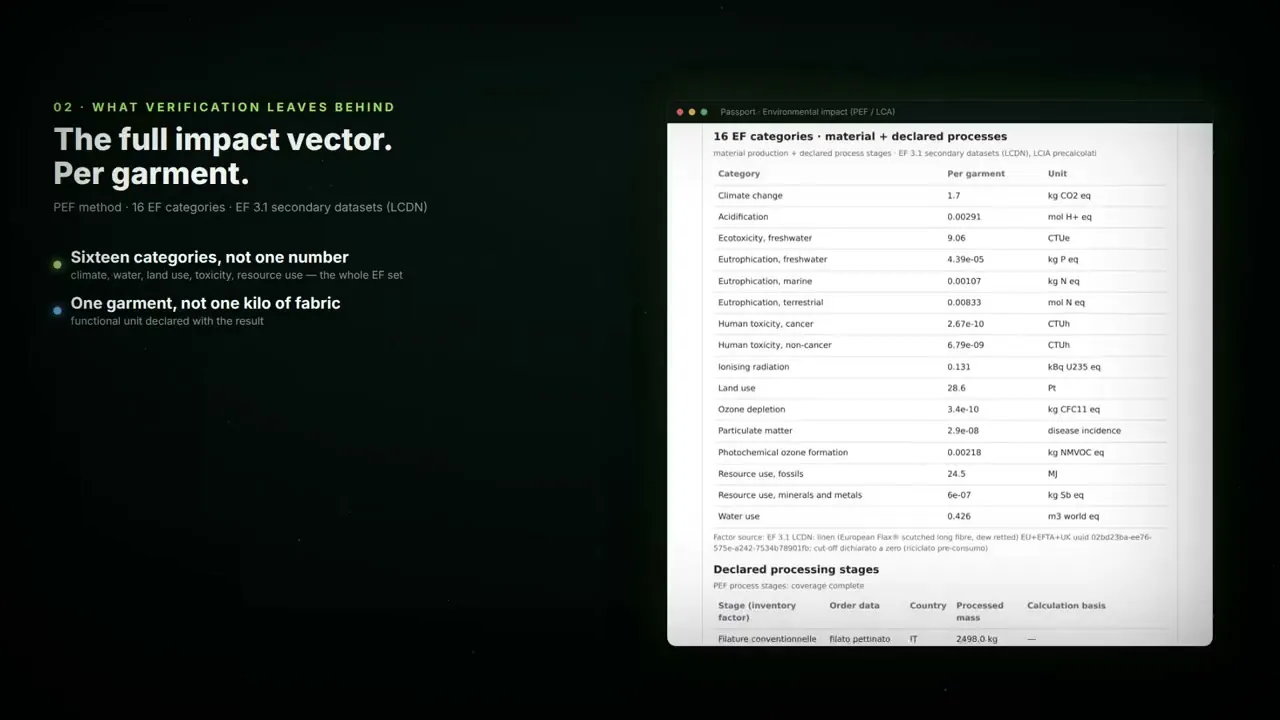
Is the footprint calculated per garment, or is it a per-kilo industry average divided by an assumption?
When the mass balance does not close, what does the passport say?
Most vendors cannot answer the first. And that is architectural, not an implementation detail: if verification depends on your uptime, your goodwill, or your continued existence, it is not verification.
Our answers are on camera, not in a brochure.
On 6 August 2026 a Sphereon Edge wallet presented a Reeco passport to our verifier over OpenID4VP. Eleven checks, eleven passed; issuance signature, holder key binding, session nonce, audience, disclosure integrity.
A single command replays the result.
The credential is a W3C Verifiable Credential (UNTP 0.7.0), issued by did:web:ia.reeco.eco, signed with Ed25519, resolvable by anyone who has never spoken to us.
16 EF impact categories, EF 3.1 datasets, per garment. Allocation from a mass balance that closes at 100% before issuance.
The footprint is labelled declared (not certified).
And the line no vendor puts in a deck: no textile passport can be conforming today.
The delegated act has not been adopted.: this is a pilot, and it says so on screen.
Ask us the three questions. Then ask everyone else.
Our passport is signed and tamper-proof
Ask what that sentence actually guarantees. It guarantees the file was not altered after issuance and nothing about whether the numbers inside were ever reconciled.
Originally published by Reeco® on LinkedIn. This is the full-text mirror on reeco.eco. Follow Reeco® on LinkedIn →