🇮🇹🇩🇪🇫🇷🇪🇸🇵🇹🇳🇱🇵🇱🇸🇪🇩🇰🇫🇮🇨🇿🇷🇴🇭🇺🇬🇷🇧🇬🇭🇷🇸🇰🇸🇮🇪🇪🇱🇹🇱🇻🇮🇪🇲🇹🇸🇦🇨🇳🇯🇵🇰🇷🇮🇳🇹🇷🇻🇳🇮🇩
I have been in CIRPASS-2 working groups long enough to recognise a pattern. A provider publishes a screenshot — a garment, a QR code, a map with little lines moving from Vietnam to Italy — and within a week it is a feature in a trade title that someone’s marketing budget paid for. Nobody asked the only question that matters. Nobody asked it because asking it is work, and the screenshot already looks like the future.
So let me state the thing plainly, and let me state it so it can be proven wrong: most fashion editors who have run a “sustainable traceability” piece in the last year have never read Regulation EU 2024/1781 against an actual customs inspection. That is falsifiable. Ask them for the access endpoint a market surveillance authority would query. Watch what comes back. Usually nothing — or a portal that only opens if the brand lets it.
I am not neutral here, and I am not going to pretend to be. I read the regulatory version. The press prints the LinkedIn version. They are not the same document, and the distance between them is exactly where the brands paying for those subscriptions are being left in the dark.
The reader pays for one service and receives another
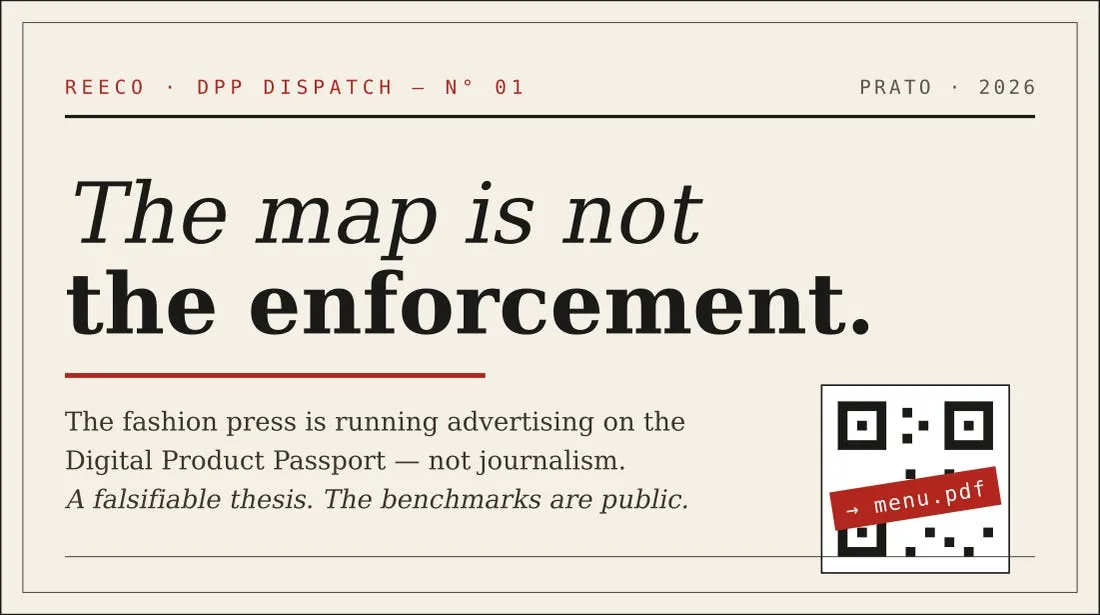
A brand pays for trade journalism to know what is coming. What it receives — when it receives anything at all on the DPP — is a paid feature in which a provider shows phantom products gliding across a map of the world, wrapped in a sea of data pulled from self-declared claims. Not verified. Just uploaded PDFs. The same gesture you make at a restaurant when you scan the menu.
A map of the world is not an enforcement system. An uploaded PDF is not a verified datapoint. A beautiful website is not an access endpoint for market surveillance authorities. These are three different claims, and the coverage collapses them into one because nobody opened the hood.
ESPR is not a document format. It is an enforcement framework, with penalties for fake commercial claims up to 4% of global turnover. The Commission adopted the first ESPR Working Plan on 16 April 2025 (COM(2025) 187). The textile delegated act is indicatively due in 2027, and the passport obligation applies roughly eighteen months after entry into force — 2028 at the earliest, 2029 in practice. That is not a distant horizon. It is the next product-development cycle → tomorrow?
The names the industry trusts — and the test they have not run
There is a list of titles that, if they did the work, would change how this industry prepares. I will name them, because naming is not an attack — it is an invitation.
Vogue Business. The Business of Fashion. WWD. FashionNetwork. Sourcing Journal. Harper’s Bazaar. Elle. Vanity Fair. Grazia. Marie Claire. Fashion Magazine. The Fashion Spot.
These are the right outlets. They have the readers, the budget, and the byline authority to do for the DPP what they have done for materials and for labour. Some already have the right people on the beat — Brooke Roberts-Islam, Sarah Kent, Bella Webb, Rhonda Richford, Jasmin Malik Chua. The talent is there. The test bench is not being run.
Because there is a test bench. Two, in fact. The UN Transparency Protocol conformance tests exist. The CIRPASS-2 testing activity exists. European Commission official DPP Registry will exist on a while . These are public, documentable, citable benchmarks. A journalist can write, in black and white, which provider exposes a verifiable endpoint and which one exposes only a dashboard. That sentence is reportable today — no leak, no embargo, no anonymous source. Only the willingness to ask for an output and check it against a standard.
A dashboard is not an enforcement API. An animated graphic of trade routes is not an audit trail. A press release announcing “ESPR readiness” is not a conformance result. Yet the coverage treats the press release as the finding. It is not the finding. It is the thing a finding would have to verify.
When fake-it-until-you-make-it works, the brand pays for it
When the investigation is missing, the prettiest website wins — not the system that works. Capital flows to the company with the best world map, not to the one with the verifiable endpoint. And when the obligation lands, the bill does not arrive at the provider with the animation. It arrives at the brand. The brand signs the passport. The brand answers to customs. The brand carries the sanction. The provider with the beautiful map has, by then, moved on to the next funding round.
On 28 March 2026 the Guardia di Finanza in Prato — where Reeco is based — seized 246,860 spools in a single operation. That is what enforcement looks like when it is real: a number, a date, a physical inventory that either reconciles or does not. A QR code resolving to a self-declared PDF survives none of that. The math does not close.
Three questions
Three questions. A desk could put them to any DPP provider tomorrow, and each one comes back as a sentence you can print.
The first is about access: show me the endpoint a market surveillance authority queries directly — not the brand’s portal, not a login the vendor controls. If the answer is a dashboard, you already have your story.
The second is about survival: show me where the passport data lives if your company is dissolved in 2029. Not the end of the contract — the end of the company. A B2B clause is not a public retention guarantee, and the brand is the one customs will come to.
The third is about the math: show me, per garment, how many units a certified mass balance actually substantiates. A Transaction Certificate for 10,000 kg of recycled polyester does not tell you how many pieces that covers. When the balance falls short of the declarations, somebody is wearing a claim that does not close — and the provider’s job is to say so. Most of them inform no one.
The service the press owes the industry
The DPP will be the most disruptive instrument the fashion supply chain has faced in a generation — more than any material, more than any label. A trade press that does not interrogate it is not informing its paying readers; it is selling them advertising and calling it coverage.
So, to the editors on that list: instead of the beautiful photographs and the coloured pages, give the market real guidance on how fashion changes before the obligation hits. You have the readers. You have the budget. You have the byline. The only thing missing is the willingness to read the regulation and run the test.
I have read it. More than once. The benchmarks are public. The case is open.
The consumer scanning the QR code will not know. The market surveillance authorities, when inspections begin, certainly will.
Stefano Cipriani is founder of Reeco®, an Expert Member of CIRPASS-2 (EWG1, EWG3), and a JRC Seville Registered Stakeholder (Unit B5). He holds patent CN113529235 on sustainable hemp fibre processing.